Satan Women Faces Body Pencil Drawings
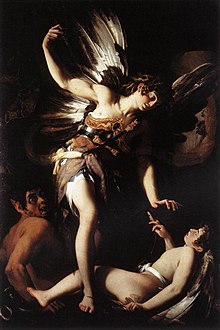
Giovanni Baglione. Sacred and Profane Dear. 1602–1603, showing dramatic compositional chiaroscuro
Chiaroscuro ( kee-AR-ə-SKOOR-oh, -SKURE-, Italian: [ˌkjaroˈskuːro]; Italian for 'calorie-free-dark'), in art, is the use of strong contrasts between calorie-free and dark, usually assuming contrasts affecting a whole limerick. It is as well a technical term used by artists and art historians for the use of contrasts of light to achieve a sense of volume in modelling three-dimensional objects and figures.[one] Similar furnishings in cinema, and blackness and white and low-primal photography, are also called chiaroscuro.
Farther specialized uses of the term include chiaroscuro woodcut for coloured woodcuts printed with different blocks, each using a unlike coloured ink; and chiaroscuro drawing for drawings on coloured paper in a dark medium with white highlighting.
Chiaroscuro is one of the canonical painting modes of the Renaissance (alongside cangiante, sfumato and unione) (see also Renaissance fine art). Artists known for using the technique include Leonardo da Vinci, Caravaggio[2] Rembrandt,[3] [iv] Vermeer[five] and Goya.[half dozen]
History [edit]
Origin in the chiaroscuro cartoon [edit]

Christ at Rest, past Hans Holbein the Younger, 1519, a chiaroscuro drawing using pen, ink, and brush, washes, white heightening, on ochre prepared paper
The term chiaroscuro originated during the Renaissance as drawing on coloured paper, where the artist worked from the paper's base tone toward low-cal using white gouache, and toward dark using ink, bodycolour or watercolour.[vii] [eight] These in turn drew on traditions in illuminated manuscripts going back to tardily Roman Imperial manuscripts on purple-dyed vellum. Such works are called "chiaroscuro drawings", simply may only be described in mod museum terminology past such formulae as "pen on prepared newspaper, heightened with white bodycolour".[9] Chiaroscuro woodcuts began as imitations of this technique.[10] When discussing Italian fine art, the term sometimes is used to mean painted images in monochrome or two colours, more generally known in English by the French equivalent, grisaille. The term broadened in meaning early on to comprehend all potent contrasts in illumination between light and nighttime areas in art, which is at present the primary significant.
Chiaroscuro modelling [edit]

Detail of La Fornarina (1518–19) past Raphael, shows delicate modelling chiaroscuro in the body of the model, for example in the shoulder, breast, and arm on the right
The more technical utilise of the term chiaroscuro is the effect of light modelling in painting, cartoon, or printmaking, where 3-dimensional volume is suggested by the value gradation of color and the analytical division of light and shadow shapes—frequently called "shading". The invention of these effects in the West, "skiagraphia" or "shadow-painting" to the Ancient Greeks, traditionally was ascribed to the famous Athenian painter of the fifth century BC, Apollodoros. Although few Ancient Greek paintings survive, their understanding of the effect of light modelling still may be seen in the late-fourth-century BC mosaics of Pella, Macedonia, in particular the Stag Hunt Mosaic, in the Business firm of the Abduction of Helen, inscribed gnosis epoesen, or 'noesis did it'.
The technique also survived in rather crude standardized class in Byzantine fine art and was refined again in the Middle Ages to become standard by the early fifteenth-century in painting and manuscript illumination in Italy and Flemish region, and then spread to all Western art.
According to the theory of the art historian Marcia B. Hall,[11] which has gained considerable acceptance,[12] chiaroscuro is one of four modes of painting colours available to Italian High Renaissance painters, along with cangiante, sfumato and unione.[xiii]
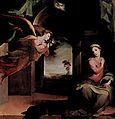
The Raphael painting illustrated, with calorie-free coming from the left, demonstrates both delicate modelling chiaroscuro to requite volume to the trunk of the model, and strong chiaroscuro in the more mutual sense, in the contrast between the well-lit model and the very night background of foliage. To further complicate matters, however, the compositional chiaroscuro of the contrast between model and background probably would not exist described using this term, every bit the two elements are almost completely separated. The term is by and large used to describe compositions where at to the lowest degree some primary elements of the primary composition evidence the transition between light and nighttime, every bit in the Baglioni and Geertgen tot Sint Jans paintings illustrated above and below.
Chiaroscuro modelling is at present taken for granted, but it has had some opponents; namely: the English portrait miniaturist Nicholas Hilliard cautioned in his treatise on painting confronting all but the minimal use we see in his works, reflecting the views of his patron Queen Elizabeth I of England: "seeing that all-time to show oneself needeth no shadow of place simply rather the open light... Her Majesty... chose her place to sit for that purpose in the open alley of a goodly garden, where no tree was near, nor any shadow at all..."[xiv]
In drawings and prints, modelling chiaroscuro frequently is achieved by the use of hatching, or shading by parallel lines. Washes, stipple or dotting furnishings, and "surface tone" in printmaking are other techniques.
Chiaroscuro woodcuts [edit]

Chiaroscuro woodcut of the Virgin and Kid by Bartolommeo Coriolano, created between 1630 and 1655 (digitally restored)
Chiaroscuro woodcuts are onetime master prints in woodcut using two or more blocks printed in unlike colours; they do not necessarily characteristic stiff contrasts of lite and dark. They were start produced to achieve similar effects to chiaroscuro drawings. Later on some early experiments in volume-printing, the true chiaroscuro woodcut conceived for ii blocks was probably first invented by Lucas Cranach the Elder in Germany in 1508 or 1509, though he backdated some of his commencement prints and added tone blocks to some prints outset produced for monochrome printing, swiftly followed by Hans Burgkmair the Elder.[15] The formschneider or block-cutter who worked in the press of Johannes Schott in Strasbourg is claimed to be the commencement one to achieve chiaroscuro woodcuts with three blocks.[16] Despite Vasari'due south claim for Italian precedence in Ugo da Carpi, it is clear that his, the beginning Italian examples, date to around 1516[17] [18] But other sources suggest, the commencement chiaroscuro woodcut to be the Triumph of Julius Caesar, which was created by Andrea Mantegna, an Italian painter, between 1470 and 1500.[xix] Another view states that: "Lucas Cranach backdated two of his works in an attempt to grab the celebrity" and that the technique was invented "in all probability" by Burgkmair "who was deputed past the emperor Maximilian to find a cheap and effective manner of getting the imperial image widely disseminated as he needed to drum up money and support for a crusade".[20]
Other printmakers who accept used this technique include Hans Wechtlin, Hans Baldung Grien, and Parmigianino. In Germany, the technique achieved its greatest popularity around 1520, just information technology was used in Italy throughout the sixteenth century. Later artists such every bit Goltzius sometimes made use of information technology. In virtually German language two-block prints, the keyblock (or "line cake") was printed in black and the tone block or blocks had flat areas of colour. In Italy, chiaroscuro woodcuts were produced without keyblocks to achieve a very unlike effect.[21]
Compositional chiaroscuro to Caravaggio [edit]

Manuscript illumination was, as in many areas, particularly experimental in attempting ambitious lighting effects since the results were not for public display. The development of compositional chiaroscuro received a considerable impetus in northern Europe from the vision of the Nativity of Jesus of Saint Bridget of Sweden, a very popular mystic. She described the infant Jesus as emitting low-cal; depictions increasingly reduced other light sources in the scene to emphasize this effect, and the Birth remained very commonly treated with chiaroscuro through to the Baroque. Hugo van der Goes and his followers painted many scenes lit just past candle or the divine light from the infant Christ. As with some later painters, in their easily the upshot was of stillness and calm rather than the drama with which it would exist used during the Bizarre.
Potent chiaroscuro became a popular upshot during the sixteenth century in Mannerism and Baroque art. Divine light continued to illuminate, oft rather inadequately, the compositions of Tintoretto, Veronese, and their many followers. The use of dark subjects dramatically lit by a shaft of light from a single constricted and ofttimes unseen source, was a compositional device adult by Ugo da Carpi (c. 1455 – c. 1523), Giovanni Baglione (1566–1643), and Caravaggio (1571–1610), the last of whom was crucial in developing the style of tenebrism, where dramatic chiaroscuro becomes a ascendant stylistic device.
17th and 18th centuries [edit]
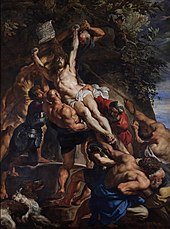
Peter Paul Rubens's The Top of the Cross (1610–1611) is modelled with dynamic chiaroscuro.
Tenebrism was particularly proficient in Spain and the Castilian-ruled Kingdom of Naples, by Jusepe de Ribera and his followers. Adam Elsheimer (1578–1610), a German creative person living in Rome, produced several nighttime scenes lit mainly by burn down, and sometimes moonlight. Unlike Caravaggio's, his nighttime areas contain very subtle particular and involvement. The influences of Caravaggio and Elsheimer were potent on Peter Paul Rubens, who exploited their corresponding approaches to tenebrosity for dramatic upshot in paintings such as The Raising of the Cross (1610–1611). Artemisia Gentileschi (1593–1656), a Bizarre artist who was a follower of Caravaggio, was also an outstanding exponent of tenebrism and chiaroscuro.
A particular genre that developed was the nocturnal scene lit by candlelight, which looked back to before northern artists such as Geertgen tot Sint Jans and more immediately, to the innovations of Caravaggio and Elsheimer. This theme played out with many artists from the Depression Countries in the first few decades of the seventeenth century, where it became associated with the Utrecht Caravaggisti such as Gerrit van Honthorst and Dirck van Baburen, and with Flemish Bizarre painters such as Jacob Jordaens. Rembrandt van Rijn's (1606–1669) early on works from the 1620s also adopted the unmarried-candle light source. The nocturnal candle-lit scene re-emerged in the Dutch Republic in the mid-seventeenth century on a smaller calibration in the works of fijnschilders such equally Gerrit Dou and Gottfried Schalken.

Rembrandt's own interest in effects of darkness shifted in his mature works. He relied less on the precipitous contrasts of light and dark that marked the Italian influences of the earlier generation, a factor found in his mid-seventeenth-century etchings. In that medium he shared many similarities with his contemporary in Italian republic, Giovanni Benedetto Castiglione, whose work in printmaking led him to invent the monotype.
Outside the Low Countries, artists such as Georges de La Bout and Trophime Bigot in French republic and Joseph Wright of Derby in England, carried on with such strong, but graduated, candlelight chiaroscuro. Watteau used a gentle chiaroscuro in the leafy backgrounds of his fêtes galantes, and this was connected in paintings by many French artists, notably Fragonard. At the cease of the century Fuseli and others used a heavier chiaroscuro for romantic effect, equally did Delacroix and others in the nineteenth century.
Employ of the term [edit]
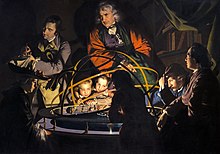
The French use of the term, clair-obscur, was introduced by the seventeenth-century fine art-critic Roger de Piles in the course of a famous argument (Débat sur le coloris), on the relative merits of drawing and colour in painting (his Dialogues sur le coloris, 1673,[22] was a key contribution to the Débat).
In English, the Italian term has been used since at least the tardily seventeenth century. The term is less oft used of fine art afterwards the late nineteenth century, although the Expressionist and other modern movements make dandy employ of the effect.
Especially since the stiff twentieth-century rise in the reputation of Caravaggio, in non-specialist use the term is mainly used for strong chiaroscuro effects such every bit his, or Rembrandt'south. As the Tate puts it: "Chiaroscuro is mostly simply remarked upon when information technology is a particularly prominent feature of the work, usually when the artist is using farthermost contrasts of light and shade".[23] Photography and cinema too have adopted the term. For the history of the term, come across René Verbraeken, Clair-obscur, histoire d'united nations mot (Nogent-le-Roi, 1979).[24]
Cinema and photography [edit]
Chiaroscuro likewise is used in cinematography to point extreme low key and high-contrast lighting to create distinct areas of low-cal and darkness in films, particularly in black and white films. Classic examples are The Cabinet of Dr. Caligari (1920), Nosferatu (1922), City (1927) The Hunchback of Notre Dame (1939), The Devil and Daniel Webster (1941), and the black and white scenes in Andrei Tarkovsky's Stalker (1979).[25]
For instance, in City, chiaroscuro lighting is used to create contrast betwixt low-cal and dark mise-en-scene and figures. The consequence of this is primarily to highlight the differences between the capitalist elite and the workers.
In photography, chiaroscuro can be accomplished with the utilise of "Rembrandt lighting". In more highly developed photographic processes, this technique also may be termed "ambient/natural lighting", although when done and then for the effect, the await is bogus and non by and large documentary in nature. In item, Nib Henson along with others, such as W. Eugene Smith, Josef Koudelka, Garry Winogrand, Lothar Wolleh, Annie Leibovitz, Floria Sigismondi, and Ralph Gibson may be considered some of the modern masters of chiaroscuro in documentary photography.
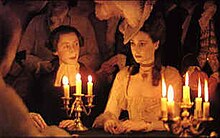
Perhaps the most direct intended use of chiaroscuro in filmmaking would be Stanley Kubrick's 1975 film Barry Lyndon.[26] When informed that no lens currently had a broad enough aperture to shoot a costume drama set up in grand palaces using just candlelight, Kubrick bought and retrofitted a special lens for these purposes: a modified Mitchell BNC photographic camera and a Zeiss lens manufactured for the rigors of space photography, with a maximum aperture of f/.7. The naturally unaugmented lighting situations in the motion-picture show exemplified low-key, natural lighting in filmwork at its most farthermost exterior of the Eastern European/Soviet filmmaking tradition (itself exemplified by the harsh low-key lighting style employed by Soviet filmmaker Sergei Eisenstein).
Sven Nykvist, the longtime collaborator of Ingmar Bergman, also informed much of his photography with chiaroscuro realism, as did Gregg Toland, who influenced such cinematographers as László Kovács, Vilmos Zsigmond, and Vittorio Storaro with his employ of deep and selective focus augmented with potent horizon-level fundamental lighting penetrating through windows and doorways. Much of the celebrated film noir tradition relies on techniques Toland perfected in the early thirties that are related to chiaroscuro (though high-key lighting, stage lighting, frontal lighting, and other effects are interspersed in means that diminish the chiaroscuro claim).
See also [edit]
- Light-and-shade watermark
- Tenebrism
Gallery [edit]
Chiaroscuro in modelling; paintings
-

Fra Angelico c. 1450 uses chiaroscuro modelling in all elements of the painting
-

Chiaroscuro in modelling; prints and drawings
-

Delicate engraved lines of hatching and cross-hatching, not all distinguishable in reproduction, are used to model the faces and dress in this late-fifteenth-century engraving
-

Another fifteenth-century engraving showing highlights and shading, all in lines in the original, used to depict volume
-
-

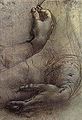
Another report by Leonardo, where the linear brand-up of the shading is easily seen in reproduction
Chiaroscuro as a major element in limerick: painting
-
-
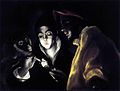
Apologue, Boy Lighting Candle in Company of Ape and Fool by El Greco, 1589–1592
-

-

-

-

-

-

Chiaroscuro as a major element in limerick: photography
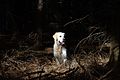


Chiaroscuro faces

Chiaroscuro drawings and woodcuts
-

A nineteenth-century version of the original type of chiaroscuro drawing, with coloured paper, white gouache highlights, and pencil shading
-

Saturn, anon. Italian, sixteenth-century?, Italian mode chiaroscuro woodcut, with iv blocks, simply no real line block, and looking rather like a watercolour
-

Ludolph Buesinck, Aeneas carries his father, German style, with line block and dark-brown tone block
Notes [edit]
- ^ Glossary of the National Gallery, London [ane] (accessed 23 October 2011)
- ^ "Caravaggio, between shadows and light". www.carredartistes.com . Retrieved 2019-01-22 .
- ^ Hall, Marcia B. (1987). Colour and Technique in Renaissance Painting: Italia and the Northward. J.J. Augustin.
- ^ "Chiaroscuro in Painting: The Power of Light and Night". EmptyEasel.com. 2007-07-20. Retrieved 2019-01-22 .
- ^ "Johannes Vermeer". Artble . Retrieved 2019-01-22 .
- ^ "Francisco Goya – Spanish Civilization". world wide web.enforex.com . Retrieved 2019-01-22 .
- ^ Harvard Art Museum glossary (accessed thirty Baronial 2007). See also Metropolitan external link
- ^ Example from the Metropolitan Archived December 20, 2008, at the Wayback Motorcar
- ^ "Holbein in England – Tate". tate.org.uk. Archived from the original on 2011-12-17. Retrieved 2012-01-31 .
- ^ David Landau & Peter Parshall, The Renaissance Print, pp. 180–84; Yale, 1996, ISBN 0-300-06883-2 – discusses these at length. Also see Metropolitan external link.
- ^ Hall, Marcia B. (1994). Colour and Meaning: Practice and Theory in Renaissance Painting. New York, N.Y.: Cambridge Academy Press. ISBN978-0-521-45733-0.
- ^ "Iv Approved Painting Modes by APA". . Retrieved June 18, 2015.
- ^ Hall, Marcia B., Rome (serial "Creative Centers of the Italian Renaissance"), pp. 148–150, 2005, Cambridge University Printing, 2005, ISBN 0521624452, 9780521624459, google books
- ^ Quotation from Hilliard's Art of Limming, c. 1600, in Nicholas Hilliard, Roy Potent, 2002, p. 24, Michael Joseph Ltd, London, ISBN 0-7181-1301-two
- ^ Landau and Parshall, 179–192; Renaissance Impressions: Chiaroscuro Woodcuts from the Collections of Georg Baselitz and the Albertina, Vienna, Royal Academy, London, March–June 2014, exhibition guide.
- ^ Steiff (1891). "Schott, Johannes". Allgemeine Deutsche Biographie (in German). Vol. 32. pp. 402–404. Retrieved 11 August 2021.
- ^ Landau and Parshall, 150
- ^ "Ugo da Carpi later on Parmigianino: Diogenes (17.50.1) | Heilbrunn Timeline of Fine art History | The Metropolitan Museum of Fine art". Metmuseum.org. 2012-02-03. Retrieved 2012-02-18 .
- ^ Emison, Patricia A. (2012). The Italian Renaissance and Cultural Retentivity. New York: Cambridge Academy Printing. pp. 105–107. ISBN978-1-107-00526-half dozen.
- ^ Brown, Marking (11 March 2014). "Revolutionary chiaroscuro woodcuts win first British exhibition". The Guardian . Retrieved 11 March 2014.
- ^ David Landau & Peter Parshall, The Renaissance Print, pp. 179–202; 273–81 & passim; Yale, 1996, ISBN 0-300-06883-2
- ^ Le rubénisme en Europe aux XVIIe et XVIIIe siècles, Volume 16 of Museums at the Crossroads, Michèle-Caroline Heck, University of Michigan, Brepols, 2005
- ^ Tate Glossary. Retrieved 30 August 2007.
- ^ Verbraeken, René (1979). Clair-obscur, histoire d'un mot. Nogent-le-Roi: J. Laget. ISBNtwo-85497-021-vii.
- ^ "Chiaroscurro in High german Expressionism".
- ^ "Victorian Studies Bulletin". Northeast Victorian Studies Clan, v. 9–xi, 1985. 1984
References [edit]
- David Landau & Peter Parshall, The Renaissance Print, pp. 179–202; 273–81 & passim; Yale, 1996, ISBN 0-300-06883-two
External links [edit]
 | Expect up chiaroscuro in Wiktionary, the free lexicon. |
- Chiaroscuro Woodcut from the Metropolitan Museum of Art Timeline of Fine art History
- Chiaroscuro woodcut from Spencer Museum of Art, Kansas
- (Modelling) chiaroscuro from Evansville University
rowlettfetwerivid.blogspot.com
Source: https://en.wikipedia.org/wiki/Chiaroscuro
0 Response to "Satan Women Faces Body Pencil Drawings"
Post a Comment