Art to Go With the Time of Elijah of the Bible
"ane Kings 17–ii Kings 2: Elijah and the Sealing Power of the Holy Priesthood," Old Testament Student Manual Kings-Malachi (1982), 59–65
(5-1) Introduction
What would you think about a homo who had the power to raise the dead, call down fire from heaven, crusade the heavens to withhold pelting, and render a barrel of flour inexhaustible?
Elijah was such a homo, a human being of power, a man of miracles, a prophet then worthy that he was translated and taken from the earth in a chariot of fire.
Small wonder that Elijah became one of the slap-up heroes in Israel'south history. Small wonder, too, that in Jewish households a place is set for him at every Passover banquet in anticipation of his return equally predicted by the prophet Malachi (run across Malachi 4:5–six).
This consignment deals with the reasons Elijah is one of the greatest prophets of all time and why he was rejected by the people of his own day.
Notes and Commentary on i Kings 17–2 Kings ii
(5-2) one Kings 17:1. What Is a Tishbite?
Elijah is here called "the Tishbite, who was of the inhabitants of Gilead." Some scholars say that Elijah came from Tishbeh, in upper Galilee (see C. F. Keil and F. Delitzsch, Commentary on the Sometime Testament, 3:1:234). Adam Clarke suggested a dissimilar identify. Elijah came, he said, from Gilead beyond the Jordan in the state given to the tribe of Gad (see The Holy Bible … with a Commentary and Disquisitional Notes, two:452). Whichever is correct, it is clear that the championship Tishbite refers to the place from which Elijah came.
(5-3) 1 Kings 17:1. Elijah Sealed the Heavens against Pelting past Priesthood Power
Elder Joseph Fielding Smith found a special significance in verse 1:
"The offset appearance of Elijah we read of is in the 17th chapter of 1st Kings, when he came before the king and said, 'As the Lord God of State of israel liveth, before whom I stand, there shall not be dew nor rain these years, just according to my word.'
"There is something very meaning in that edict. I want you lot to get it. Follow me again closely: 'As the Lord God of Israel liveth, earlier whom I stand up, there shall not be dew nor rain these years, but according to my word.' The reason I put emphasis upon this is to impress yous with the sealing ability by which Elijah was able to close the heavens, that there should be no rain or dew until he spoke." (Doctrines of Conservancy, 2:102.)
(5-iv) ane Kings 17:iii. Where Is the Brook Cherith?
"We do not know which of the Jordan tributaries the brook Cherith might have been, but plain it was an obscure and isolated place where Elijah could hide safely without beingness accidentally discovered past soldiers, shepherds or passersby. It was too a desolate place where no animal life existed, therefore Elijah was completely dependent upon the Lord for his sustenance." (W. Cleon Skousen, The 4th 1000 Years, p. 336.)
(v-5) ane Kings 17:4, half dozen. Who Fed Elijah?
Some scholars insist that the word raven is a mis-translation and that merchants or traders is the correct rendering. Other scholars disagree. They insist that the Hebrew give-and-take is properly translated just as it stands. The fact that Elijah was in hiding makes information technology unlikely that merchants or traders would come to him twice a day, and the tone of the writer suggests that it was miraculous care rather than a normal interaction betwixt Elijah and other men.
(5-6) ane Kings 17:9. The Widow of Zarephath
Zarephath was on the coast of the Mediterranean betwixt Tyre and Sidon, in what is at present Lebanese republic and was then Phoenicia, outside the boundaries of Israel. The poor widow had but a piddling flour with which to brand a patty to fry. Her barrel would take been an earthen jar and her cruse a dirt bottle. Wooden barrels are not suitable for storing flour in the Centre East because they do not protect the flour from insects.
Elijah's request for the widow to set his food was not a selfish request but rather a examination of her organized religion. Because she passed the exam, Elijah's promise that her barrel of flour and cruse of oil would not fail for the duration of the famine was fulfilled. This widow non only provided for her own needs in a time of great distress just provided for others an example of great religion. In an effort to open up the eyes of his prejudiced countrymen, Jesus spoke of this Sidonian woman who obeyed God'due south command and physically sustained His prophet. "Simply I tell yous of a truth, many widows were in Israel in the days of Elias, when the sky was close up three years and six months, when great famine was throughout all the land; only unto none of them was Elias sent, save unto Serepta, a city of Sidon, unto a woman that was a widow" (Luke 4:25–26).
(five-7) 1 Kings 17:17–24. Elijah Raised the Dead
This is the fourth phenomenon mentioned in this affiliate which Elijah performed by ways of his priesthood power. First he brought dearth by his word (run into v. 1), then he was fed past ravens (see v. 6), then he caused the widow's nutrient supply to miraculously go on (see vv. 13–16). And then he worked another mighty phenomenon through the power of God. The widow's cry (see v. 18) was more a plea for help than a criticism. In essence she was saying, "I thought sheltering a prophet would bring blessings and protection; instead, tragedy has struck my home."
(5-8) one Kings eighteen:1–16. Elijah Was Sent to Meet Ahab
Obadiah was the king'south chamberlain, or governor of his house. As such it was his responsibility to accommodate the rex's appointments. That is why Elijah told Obadiah to gear up an interview between the prophet and King Ahab. The fact that a king and his chief steward had to look for h2o and grass by themselves shows that the famine had become acute (see vv. v–6).
Ahab knew that Elijah had brought this distress, so he searched for him. Manifestly Ahab had considerable ability and authority among surrounding nations, for he was able to exact promises for them that they were not concealing Elijah or that they knew of his whereabouts (see five. 10). Sometimes, however, someone would see the prophet. But when he reported seeing Elijah, the prophet had disappeared by the time Ahab got there. Ahab then killed the person who said he had seen Elijah. Obadiah's fright that Elijah would disappear again was caused by his awareness that Ahab would not hesitate to take him executed if he failed to deliver Elijah (see vv. 12–16). Elijah promised Obadiah that he would appear before Ahab (meet v. 15).
Whether this Obadiah, who "feared the Lord profoundly" (five. three), is the author of the Erstwhile Testament book of the same name is not known, merely it is doubtful.
(5-nine) 1 Kings 18:17–18. Who Has Troubled Israel?
These verses have inspired many sermons, for the wicked unremarkably arraign someone else for their misfortunes. Elijah had no ability by himself to bring on the famine. He was merely the agent of the Lord. Ahab and his policies were the truthful cause of Israel's distress, but the king refused to accept that responsibility.
(5-10) 1 Kings 18:19. Mount Carmel
Mountain Carmel is a mount ridge several miles long that runs from southeast to northwest. Its southeastern slopes are very most the northwestern corner of the corking Jezreel Valley, and its northwest edge juts into the Mediterranean on the northern coasts of modern Israel. Rising abruptly to virtually eighteen hundred feet higher up ocean level, information technology is an impressive prominence and became synonymous with beauty. It is referred to figuratively in the Doctrine and Covenants. (come across D&C 128:19.)
(5-11) 1 Kings 18:21. "How Long Halt Ye between Two Opinions?"
Clarke offered the following comment on Israel's indecision: "Literally, [the phrase means] 'How long hop ye near upon 2 boughs?' This is a metaphor taken from birds hopping about from bough to bough, not knowing on which to settle. Perhaps the idea of limping through lameness should not be overlooked. They were halt, they could not walk uprightly; they dreaded Jehovah, and therefore could non totally abandon him; they feared the king and queen, and therefore thought they must embrace the religion of the country. Their censor forbade them to do the one-time; their fear of man persuaded them to do the latter; only in neither were they heartily engaged; and at this juncture their minds seemed in equipoise, and they were waiting for a favourable opportunity to brand their decision. Such an opportunity at present, through the mercy of God, presented itself." (Commentary, 2:457.)
(5-12) 1 Kings 18:22–24. The Claiming
The competition that Elijah proposed should have appealed to the prophets of Baal, since their god, the "Sun-god," could surely send down fire if anyone could. Added to the iv hundred and fifty priests of Baal were four hundred priests of his female counterpart, Ashtoreth, or Venus, whom Jezebel worshiped. Elijah commented on the number of prophets of Baal in contrast to the number of prophets of the Lord (run into five. 22).

Ashtoreth
(5-xiii) 1 Kings eighteen:25–29. How Long Did the Priests of Baal Call upon Their God? Why?
Elijah's mocking words recorded in poesy 27 furnished cause for a renewed frenzy among Baal'south prophets. Elijah was really maxim, "Cry louder; if he is a god, he tin can surely hear you. Just and then, maybe, he's away on a trip, or he'southward out hunting (pursuing game), or maybe he's asleep." Such taunting kept the priests of Baal in action all solar day long. Clarke commented: "From morning even until noon. It seems that the priests of Baal employed the whole mean solar day in their desperate rites. The time is divided into two periods: 1. From morning until apex; this was employed in preparing and offer the sacrifice, and in hostage supplication for the angelic fire. Notwithstanding there was no respond, and at noon Elijah began to mock and ridicule them, and this excited them to commence afresh. And, ii. They continued from apex till the time of offer the evening sacrifice, dancing up and down, cutting themselves with knives, mingling their own claret with their sacrifice, praying, supplicating, and acting the nearly frantic manner." (Commentary, 2:457.)
(5-fourteen) 1 Kings 18:28. Why Did the Priests of Baal Cutting Themselves as They Called Out to Their God?
Apparently they idea this human action of cocky-abasement would endear them to their god, get his attention, and evidence their sincerity. One ancient writer told of antics very similar to these that he observed in Gaza in Roman times:
"'A trumpeter went earlier them who proclaimed their arrival in the villages, the farmyards, or the streets of towns, by flourishes on his instrument—a twisted horn. The begging Galli followed in fantastic assortment, after a leader: an ass in their midst, carrying their begging bag and a veiled image of the goddess. … They danced along the streets to the sound of wild music, property huge swords and bills, with whips for scourging themselves, in their hands, and making a hideous noise with rattles, fifes, cymbals or kettle-drums. When they came to a farmyard they began their ravings. A wild howl opened the scene. They and so flew wildly one by the other: their heads sunk low towards the world, as they turned in circles: their loose hair dragging through the dust. Presently they began to seize with teeth their arms, and next to hack themselves with the two-edged swords they carried.' …
"So began a new scene. 'Ane of them, the leader in this frenzy, commenced to prophesy, with sighs and groans, lamenting aloud his by sins, which he would now avenge by the chastisement of his flesh. He then took the knotted whip and lashed his dorsum, cut himself also with his sword till the blood ran downwards.'" (In Cunningham Geikie, Hours with the Bible, 3:399–400.)
(5-15) 1 Kings 18:33–35. Why Did Elijah Have the Place of Sacrifice Drenched with Water?
The priests of Baal were and so unscrupulous that they rigged their altars with fires beneath them to make the sacrifices announced to ignite spontaneously. One ancient author said he "had seen under the altars of the heathens, holes dug in the earth with funnels proceeding from them, and communicating with openings on the tops of the altars. In the onetime the priests concealed fire, which, communicating through the funnels with the holes, fix burn down to the forest and consumed the sacrifice; and thus the uncomplicated people were led to believe that the cede was consumed by a miraculous burn." (In Clarke, Commentary, 2:459.)
Elijah undoubtedly drenched the altar and sacrifice with h2o as much for the heathen priests every bit for the people. He wanted to convince them that there was no trickery and to show them that the ability of the Lord was manifest. It was a bold and dramatic move that demonstrated his absolute confidence in the ability of the true God.
(five-xvi) 1 Kings eighteen:38. What Was the Fire of the Lord?
"The burn down proceeding from Jehovah, was not a natural wink of lightning, which could not produce any such effect, only miraculous burn falling from heaven, as in [1 Chronicles 21:26; 2 Chronicles 7:1] (run across [Leviticus nine:24]), the supernatural origin of which was manifested in the fact, that information technology not only consumed the sacrifice with the pile of forest upon the chantry, merely besides burned up … the stones of the altar and the earth that was thrown upwards to form the trench, and licked up the h2o in the trench. Through this miracle Jehovah not just accredited Elijah as His servant and prophet, merely proved Himself to be the living God, whom State of israel was to serve; so that all the people who were present brutal downwardly upon their faces in worship, as they had done in one case before, viz. at the induction of the altar in [Leviticus nine:24], and confessed 'Jehovah is God.'" (Keil and Delitzsch, Commentary, 3:1:249.)
(5-17) 1 Kings 19:2–eight. Elijah Fled Jezebel
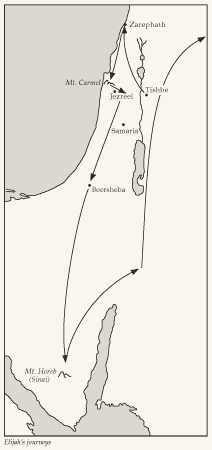
These verses evidence how powerful and decadent Jezebel was. Even after the miraculous fire from heaven, this woman was moved only to anger and swore she would accept Elijah's life in revenge. Elijah fled, first into the territory of Judah (at Beersheba) and and then to Mount Horeb (or Sinai) 150 miles further s.
Elijah was either fasting or receiving food provided by the Lord during this period. If Elijah truly went without nutrient for forty days, as verse 8 suggests, and then he had an feel similar to that of Moses (meet Exodus 24:18; 34:28; Deuteronomy ix:9–25) and the Savior (run into Matthew iv:2). And like Moses at Sinai, Elijah in that location received revelations.
It must have been very lonely for Elijah during this menstruum. Men were seeking his life, he felt himself to exist the only faithful prophet left in Israel, and he was hiding in a cave. President Joseph Fielding Smith wrote: "When he was there, the Lord chosen upon him and asked him what he was doing there; and in his sorrow, because of the hardness of the hearts of the people, he told the Lord the status, that he alone remained, that they sought his life to accept it away. But the Lord showed him that there were others who had remained true unto him, fifty-fifty seven,000." (Doctrines of Salvation, 2:106.)
Those who listen for God'due south voice know that information technology is non in the power to break rocks and earth (encounter 5. 11), nor in the burn down, only in the "still minor vocalization" that speaks to the center of man. When Elijah heard the still small vocalism, he "went out" to converse with the Lord (five. thirteen). Encouraged, Elijah returned at the Lord's asking and completed his assigned mission. The give-and-take jealous as used in verses 10 and 14 means diligent. The new prophet chosen to succeed Elijah was Elisha.
(five-eighteen) 1 Kings 19:four–sixteen. Where Did Elijah's Travels Have Him?
The accompanying map shows the journeys of Elijah from the time he left the Brook Cherith until he arrived at Damascus, Syrian arab republic, where he all-powerful an earthly king in a foreign land. It provides a picture of how far-reaching his ministry was.
(5-19) 1 Kings 19:15. Jehovah, the God of Many Nations
This verse shows that God and Israel'due south prophets influenced nations other than Israel. Nothing more than is known about the circumstance that fabricated it possible for Elijah to anoint a rex of Syrian arab republic.
(5-20) 1 Kings xix:17. Whom Did Elisha Slay?
There is no record of Elisha slaying anyone. This passage may mean that Elisha would prophesy the death of sure people. Of class, the Bible record as information technology is now is bitty at best, and the details of the incident referred to here may exist lost.
(5-21) 1 Kings xix:19–21. Twelve Yoke of Oxen
Elisha must have been wealthy to have been plowing with twelve yokes of oxen, for each yoke pulled a plow and was driven by a servant. The feast of ii oxen also indicates wealth. Eating the oxen and called-for their equipment symbolically represents Elisha'south rejection of worldly wealth as Elisha prepared to follow Elijah and to make the considerable material sacrifice involved in responding to the prophetic phone call.
(5-22) 1 Kings 19:xix. What Was the Mantle of the Prophet That Was Placed on Elisha?
A mantle is a coat or like roofing.
"When Elijah walked upwardly to the plow where Elisha was continuing the prophet simply removed his rough mantle and placed information technology beyond the shoulders of Elisha. The astonished Elisha seemed to have known exactly what this emblematic gesture meant. He was being designated for the prophetic calling and being called as the understudy and futurity successor of Elijah. No lengthy discussion or art of persuasion was employed to induce Elisha to accept the call. It was not needed. He was i of the pick vii,000 referred to past the Lord who had not bowed the knee to Baal but respected the Holy Priesthood of God and accepted with enthusiasm the subject field and obedience required by such a calling." (Skousen, Fourth Thousand Years, p. 359.)
Out of this elementary human activity, the phrase "mantle of the prophet" has come to mean the calling and role of the prophet.
(five-23) 1 Kings 20:eleven. "Let Not Him That Girdeth on His Harness Boast"
This is similar proverb "Don't boast of the human action until it is done." The imagery comes from the harnessing of work animals. It would be easy for an ox to boast of how much he can turn while he is being harnessed in the morning, simply the boast would be meaningful simply afterward the piece of work was done, that is, when the harness is taken off.
(5-24) one Kings twenty, 22. Battles with Syria
These chapters item two separate battles between Israel and Syrian arab republic. Israel won the starting time boxing only lost the second.
(5-25) i Kings 20:28. What Is Meant by the Phrase "the Lord Is God of the Hills, but He Is Not God of the Valleys"?
"At that place seems to be an allusion here to the stance, prevalent amongst all infidel nations, that the different parts of the earth had dissimilar divinities. They had gods for the woods, for the mountains, for the seas, for the heavens, and for the lower regions. The Syrians seem to have received the impression that Jehovah was specially the God of the mountains; but he manifested to them that he ruled every-where." (James 1000. Freeman, Manners and Customs of the Bible, p. 165.)
(5-26) 1 Kings 20:38–43. Ahab's Death Pronounced
In his meet with the prophet of the Lord, Ahab unwittingly pronounced his own doom. The prophecy was fulfilled in the adjacent battle with the Syrians (run across 1 Kings 22:34–35). That was his reward for failing to slay Ben-hadad as the Lord had commanded.
(v-27) 1 Kings 21:2–24. Naboth's Vineyard
Ahab's offer to buy Naboth's vineyard may seem off-white at outset glance, but Naboth could not sell. His land had been inherited from his forefathers, and the law of Moses did non permit the sale of one's inheritance, except in cases of farthermost destitution, and then it could be sold or mortgaged merely until the fourth dimension of jubilee, when it would be reclaimed. Ahab wished to acquire the land permanently. Hence Naboth'southward reply: "The Lord forbid it me" (v. 3). Ahab'southward tantrum over being refused (see v. 4) gives an insight into the graphic symbol of Ahab. The king owned ten-twelfths of the land of Israel already, but he was miserable because he could not get everything he wanted.
These verses also show how Ahab'south wife, Jezebel, arranged her husband's diplomacy without hindrance of whatever sort (meet five. 16). The phrase "sons of Belial," was a catch-all term that applied to most whatsoever evil persons—liars, thieves, murderers. Notice how the penalization pronounced on Ahab and Jezebel matched their graphic symbol (run into vv. 19, 23).
(5-28) 1 Kings 21:27–29. Sins of the Fathers and the Sons
Because of Ahab'south wicked life, the Lord prophesied that he would lose his posterity (see 1 Kings 21:21). Verses 27 through 29 show the relationship between repentance and the consequences of sin. Because Ahab repented, the "evil" was delayed until Ahab's son was king.
(5-29) 1 Kings 22:2–16. Ahab and Jehoshaphat
The friendship between Ahab, male monarch of Israel, and Jehoshaphat, rex of Judah, may have adult considering Jehoram, Jehoshaphat's son, had married Ahab'southward girl Athaliah. This friendship did not please the Lord, and Jehoshaphat was severely rebuked for encouraging it (see 2 Chronicles 19:1–3).
Ahab and Jehoshaphat were considering whether they should combine to fight confronting the Syrians. Ahab's false prophets, or counselors, said yes, but Micaiah, a prophet of God, said no. The words of Micaiah in verse 15, "Get and prosper," were said with great sarcasm. It is as though Micaiah said: "All your false prophets have predicted success. You desire me to practise the same, so I will: 'Go and prosper.'" This was said scornfully to let King Ahab know that it was reverse to Micaiah's truthful advice. Hence the Rex's response in poesy 16.
(5-30) 1 Kings 22:23–24. Did the Lord Identify a "Lying Spirit" in Ahab's Prophets?
The Lord does not place a lying spirit in anyone. As Clarke explained, the Hebrew expression means that the Lord "hath permitted or suffered a lying spirit to influence thy prophets. Is it requisite again to remind the reader that the Scriptures repeatedly correspond God as doing what, in the grade of his providence, he but permits or suffers to be done? Nil can be washed in sky, in earth, or hell, merely either by his firsthand energy or permission. This is the reason why the Scripture speaks as above." (Commentary, ii:476.)
(5-31) 1 Kings 22:34. What Are the "Joints of the Harness"?
An ancient warrior was covered with armor. To kill him, an arrow had to pass through the spaces where ane piece of armor joined another.
(5-32) 2 Kings 1:1. Who Were the Moabites Who "Rebelled against State of israel later the Death of Ahab"?
The Moabites occupied the territory east of the Expressionless Sea. They were the descendants of Lot (run across Genesis xix:37.) Years before David had conquered them and their distant relatives the Ammonites, who were also descendants of Lot and who occupied a territory merely northward of Moab. The Moabites at present saw an opportunity to break connectedness with the Israelites, and they were determined to brand the most of it. Their king, a man named Mesha, was so proud of the Moabites' rebellion that he wrote about it on a large black stone that has been discovered by archeologists. More details of the rebellion are constitute on this stone than are recorded in the Bible. Mesha recorded on the stone the account of hundreds of cities being added to his kingdom and how he congenital reservoirs, aqueducts, and fortifications.
(5-33) 2 Kings 1:3. Who Is Baalzebub?
"This name for Satan signifies his position as the prince or chief of the devils. It is the same name (Baalzebub) equally was given to an aboriginal pagan god. (2 Kings i:3.) In their rebellion against light, the aboriginal Jews practical the proper noun Beelzebub to Christ (Matt. 10:25), and also said that he cast out devils past the ability of Beelzebub. (Matt. 12:22–30.)" (Bruce R. McConkie, Mormon Doctrine, p. 75.)
(5-34) 2 Kings ane:eight. Elijah'southward Description
The statement that Elijah "was a hairy man" refers to the fact that the prophet was dressed in a crude garment, probably made of either goat's or camel's pilus. Maybe he actually wore an animate being's peel with the hair still on it (see Hebrews 11:37).
(five-35) 2 Kings 1:9–xiv. Was Information technology an Act of Cruelty to Destroy These Soldiers?
"Some take blamed the prophet for destroying these men, by bringing downwardly fire from heaven upon them. But they do not consider that it was no more than possible for Elijah to bring down fire from heaven, than for them to do information technology. God lonely could send the fire; and every bit he is but and skillful, he would non have destroyed these men had there not been a sufficient cause to justify the deed. It was non to please Elijah, or to appease whatsoever vindictive humour in him, that God thus acted; but to show his own power and justice. No entreaty of Elijah could take induced God to accept performed an act that was incorrect in itself. Elijah, personally, had no business in the business concern. God led him simply to denote on these occasions what he himself had determined to do. If I be a man of God, i. e., as surely as I am a man of God, fire shall come up down from heaven, and shall consume thee and thy l. This is the literal significant of the original; and by information technology we see that Elijah'southward words were simply declarative, and not imprecatory." (Clarke, Commentary, 2:482.)
(5-36) 2 Kings 1:17. Jehoram and Jehoram
There were ii Jehorams who were contemporaries: Jehoram, son of Ahab, in the Northern Kingdom; and Jehoram, son of Jehoshaphat, in the Southern Kingdom.
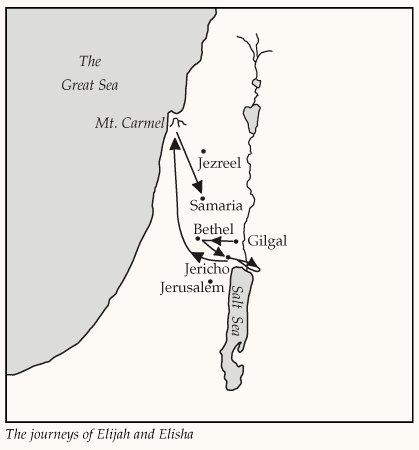
(5-37) ii Kings 2. Where Did the Journeys of Elijah and Elisha Have Them?
It is clear from this chapter that Elijah and Elisha moved nigh a great deal during this menstruation. Meet the accompanying map for the course of their travels.
(5-38) ii Kings 2:8. Crossing the Jordan with Elijah
Here is yet some other miracle performed by the priesthood Elijah held. He divided, or unsealed, the waters of the Jordan. He brought this aforementioned priesthood power, and the keys to practise it, to Peter, James, and John on the mountain of transfiguration (see Matthew 17:1–13; Joseph Smith, Teachings of the Prophet Joseph Smith, p. 158).
(5-39) 2 Kings 2:eleven. Was Elijah Really Taken into Sky?
The term heaven has more than than one meaning. Sometimes it is used to mean the sky; at other times it refers to the angelic glory. Elijah was taken from this globe as a translated being, but not into celestial glory. The Prophet Joseph Smith taught:
"Many have supposed that the doctrine of translation was a doctrine whereby men were taken immediately into the presence of God, and into an eternal fullness, but this is a mistaken idea. Their place of habitation is that of the terrestrial social club, and a place prepared for such characters He held in reserve to be ministering angels unto many planets, and who as yet have not entered into then great a fullness equally those who are resurrected from the dead. 'Others were tortured, not accepting deliverance, that they might obtain a better resurrection.' (encounter Hebrews 11:35.)
"At present it was axiomatic that there was a better resurrection, or else God would non have revealed it unto Paul. Wherein and then, tin it be said a ameliorate resurrection. This distinction is made between the doctrine of the actual resurrection and translation: translation obtains deliverance from the tortures and sufferings of the body, merely their being will prolong as to the labors and toils of the ministry building, before they can enter into and so great a residuum and glory." (Teachings of the Prophet Joseph Smith, pp. 170–71.)
(5-40) 2 Kings 2:xiv. Elijah'southward Mantle
Elijah'south cloak, or mantle, was a symbol of his say-so. Possession of it symbolized that Elijah's former say-so now rested on Elisha. (See Notes and Commentary on i Kings 19:19.)
(five-41) 2 Kings 2:twenty. Does Salt Purify Water?
The use of salt makes this a greater miracle, since common salt normally corrupts rather than purifies h2o.
(v-42) 2 Kings 2:23–24. Should Elisha Exist Blamed for the Death of These "Children"?
In answering this question consider the following interpretations:
-
The word that in the Male monarch James Version is translated "fiddling children" means immature every bit compared to quondam, and can exist translated not just as kid, but as immature man, meaning a retainer or 1 fit to go out to battle.
-
In poetry 24 the idea ends. This ending is indicated past a menstruum after "and cursed them in the name of the Lord." The verse then states that 2 she bears came out of the wood. The assumption that Elisha directed the bears may not exist justified. Clarke suggested: "But is information technology not possible that these twoscore-ii were a set of unlucky young men, who had been employed in the woods, destroying the whelps of these same she-bears, who at present pursued them, and tore them to pieces, for the injury they had washed? We have already heard of the ferocity of a bear robbed of her whelps; see at the end of [2 Samuel chap. 17]. The mention of she-bears gives some color to the in a higher place theorize; and, probably, at the time when these young fellows insulted the prophet, the bears might exist tracing the footsteps of the murderers of their young, and thus came upon them in the midst of their insults, God's providence ordering these occurrences and then as to make this natural upshot announced as a Divine cause. If the conjecture be correct, the bears were prepared past their loss to execute the expletive of the prophet, and God'due south justice guided them to the spot to punish the iniquity that had been but committed." (Commentary, 2:486.)
Points to Ponder
(five-43) The Living and the Dead Prophets
This section'south reading concerned two prophets, Elijah and Micaiah, whose counsel Ahab disliked. Fifty-fifty though Jehoshaphat did not like the counsel he and Ahab received, Ahab still did not want to seek advice from Micaiah, for Micaiah refused to flatter him (1 Kings 22). Because Ahab did not like what any of the prophets had to say virtually him, he persecuted them.
Now, however, Elijah is honored by people the globe over, Jew, Christian, and Moslem, as one of history's greatest prophets.
Is it easier to believe a dead prophet because his counsel applies more than directly to another time? Elder Bruce R. McConkie said:
"It seems easy to believe in the prophets who have passed on and to suppose that nosotros believe and follow the counsel they gave under different circumstances and to other people. But the peachy test that confronts united states, every bit in every age when the Lord has a people on earth, is whether we will requite heed to the words of his living oracles and follow the counsel and direction they give for our day and fourth dimension.
'We be Abraham's children, the Jews said to Jove;
Nosotros shall follow our Male parent, inherit his trove.
But from Jesus our Lord, came the stinging rebuke:
Ye are children of him, whom ye list to obey;
Were ye Abraham's seed, ye would walk in his path,
And escape the stiff bondage of the begetter of wrath.
'Nosotros have Moses the seer, and the prophets of old;
All their words nosotros shall treasure as silver and gilt.
But from Jesus our Lord, came the sobering vocalisation:
If to Moses ye plough, then give heed to his word;
Simply then can ye promise for rewards of great worth,
For he spake of my coming and labors on earth.
'We have Peter and Paul, in their steps let usa trod;
So religionists say, every bit they worship their God.
But speaks He who is Lord of the living and expressionless:
In the hands of those prophets, those teachers and seers,
Who abide in your mean solar day have I given the keys;
Unto them ye must plow, the Eternal to please.'"
(In Conference Report, April. 1974, pp. 100–101; or Ensign, May 1974, pp. 71–72.)
Sometimes modern Saints autumn into the aforementioned traps equally did aboriginal State of israel. Have yous heard people extol the teachings of Joseph Smith but murmur and criticize current Church building leaders for a statement or a stand they accept that contradicts the private's personal ideas or preference? Do we say we honor the prophets and yet not follow their instructions from the last general conference? Some who read the Old Testament have a tendency to shake their heads sorrowfully over those proud and rebellious people. But the great value of our studying this work is that it provides a clear standard for measuring our own beliefs.
(5-44) Who Was It That Troubled Israel?
Do you lot call up the exchange between Ahab and Elijah at the finish of the three-twelvemonth drought? Ahab asked the prophet, "Art thou he that troubleth State of israel?" And Elijah replied, "I have not troubled State of israel; but thou, and thy father'due south house, in that ye take forsaken the commandments of the Lord" (i Kings 18:17–18).
By himself Elijah had no power to create a drought, call downwards fire from sky, bring about the end of Ahab and his firm, or punish or destroy Israel. He was only an musical instrument in the hands of the Lord. Information technology was the wickedness of State of israel that created the chaos and calamity. In some cases the Lord intervened to punish directly. In others He simply let the laws He gave the world (encounter D&C 88:42) run their class. Elijah knew what he prophesied but because he was the one called to reveal it. Who would think that idolatry could lead people to break as many other laws every bit it did in Elijah's 24-hour interval?
Information technology is easy to await back and encounter how foolish Ahab, Jezebel, and the Israelites who halted betwixt two opinions were. But what of today? Are men still inclined to vacillate between serving God and serving the devil? Do they notwithstanding want to hear merely skilful things nearly their evil choices? Do they still tend to place the blame for life's reversals on someone else? Or will they learn the eternal fact that men reap precisely what they sow? "For he that soweth to his mankind shall of the flesh reap corruption; only he that soweth to the Spirit shall of the Spirit reap life everlasting" (Galatians 6:8).
Elder Bruce R. McConkie said that "the great demand in the world today is non for the Lord to send a prophet to reveal his mind and will. He has done that; we have a prophet; nosotros are guided by many men who have the spirit of inspiration. The great need today is for men to have a listening ear and to give mind to the words that fall from the lips of those who vesture the prophetic mantle." (In Briefing Report, Apr. 1974, p. 104; or Ensign, May 1974, p. 73.)
rowlettfetwerivid.blogspot.com
Source: https://www.churchofjesuschrist.org/study/manual/old-testament-student-manual-kings-malachi/chapter-5?lang=eng
0 Response to "Art to Go With the Time of Elijah of the Bible"
Post a Comment